special
Vapor Screen
Exclusive
Brazil stands as the world's largest exporter of tobacco leaf and the third-largest producer, with 138,000 farming families—most of them concentrated in the country's southern region—sustaining this vast production. If the global rise of new products such as electronic cigarettes and nicotine pouches continues, demand for this raw material could drop sharply.
The explanation is simple: these products use nicotine, but not necessarily from the tobacco plant. It may come from other leaves rich in the molecule or be synthesized in a laboratory. And even when the nicotine in these new products is derived from tobacco, the demand for raw material is lower.
The future is uncertain. Yet Brazilian tobacco farmers remain unaware of the risks posed by this market shift. Not through any fault of their own—the tobacco industry has been selling them the promise of a bright future, by promoting flashy figures on income growth and rural job creation.
We dug into these numbers, into the reports of the largest companies operating in Brazil, and into the industry's secret archives. We spoke with entrepreneurs in the nicotine business, market consultants, researchers, politicians, and tobacco farmers.
O Joio e O Trigo reveals what lies behind the vapor screen crafted to keep Brazilian tobacco farmers from viewing electronic cigarettes as a threat—and even to win their support for legalization in Brazil.
We also examine the role of public authorities in this scenario. Today, farmers in tobacco-growing regions are pursuing alternatives to tobacco cultivation on their own, but there is little market for other crops, such as food.
Numbers

Philip Morris' global revenue
2016
97.25%
2024
61.3%
CIGARETTES
BAT's sales numbers
2017
732 billion
units
2024
505 billion
units
CIGARETTES
2016
2.75%
2024
37.82%
VAPES, SACHETS AND HEATED TOBACCO PRODUCTS
2017
140 million
units
2024
616 million
units
VAPES
Reports
Less tobacco, more nicotine: how the cigarette industry is planning for vape crops in Brazil
Tobacco companies promise a "new source of income" for farmers through nicotine for vapes. Exclusive documents show that those devices require very few farmers and crops different from those traditionally cultivated in the country.
Lula Government Delays Tobacco Growing Phase-Out Program
The initiative has been sitting in the minister of Agrarian Development's office since December 2024. Without support from public policies, farmers in tobacco-growing regions face losses when trying to invest in other crops.
BAT inflate data to promise jobs if vapes are legalized in Brazil
Company claims the devices would create 13,000 new jobs in rural areas, but BAT's e-cigarettes are manufactured in China and, even if they used nicotine extracted from Brazilian tobacco, production would require fewer than 100 farmers.
Fact sheet
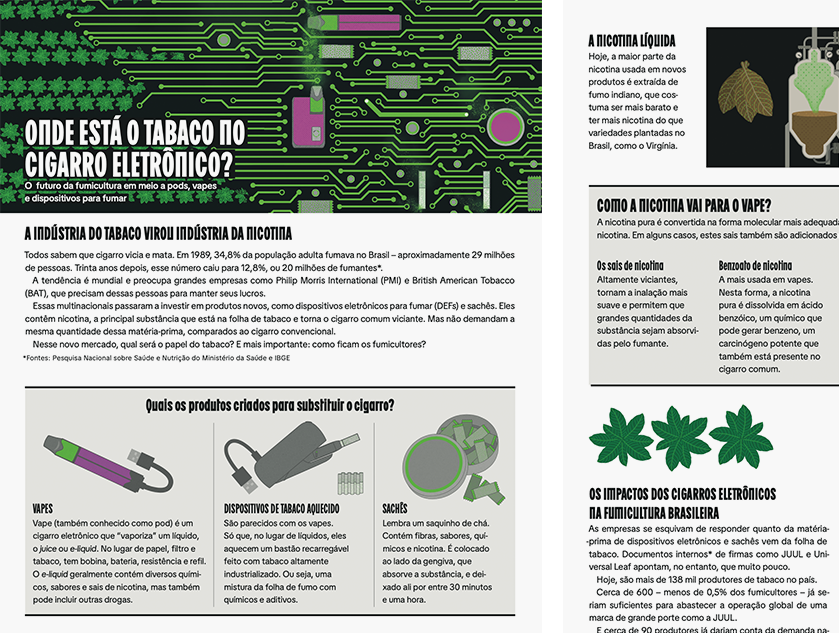
Where is the tobacco in the electronic cigarette?
Download a summary of this material here, designed to be circulated and discussed in tobacco-growing regions.
Click here to download