

Less tobacco, more nicotine: how the cigarette industry is planning for vape crops in Brazil
Tobacco companies promise a "new source of income" for farmers through nicotine for vapes. Exclusive documents show that those devices require very few farmers and crops different from those traditionally cultivated in the country.
*contributed Raquel Torres
In the late 1970s, veteran Benício Werner, who has been a director of the Brazilian Tobacco Farmers Association (Afubra) for 50 years, brought cigarettes to a compounding pharmacy. The goal was to find out how much tobacco they contained and cross-reference that data with sales figures. "If you know the average, you can calculate and alert the producer," he explains. "We need to know how much demand there is to adjust production." This is market logic: a controlled supply of leaf tobacco means better prices when farmers sell their crop.
But with the global rise of electronic cigarettes, the rules have changed. Banned in Brazil since 2009 by the National Health Surveillance Agency (Anvisa), they use batteries and coils instead of paper and filters. It is also difficult to know whether they contain tobacco. Many use nicotine, the highly addictive substance found in the leaf and in conventional cigarettes. In vapes, it is mixed with chemicals and flavors, but is not necessarily extracted from the tobacco plant. It can come from other nicotine-rich leaves or be synthesized in a laboratory.
The cigarette industry, which could enlighten producers about the impact of this novelty on cultivation, has no interest in keeping them informed. "Technical knowledge, precise information — all of this is a very big unknown for us," Afubra president Marcílio Drescher told Joio. The trade association, created to guarantee rural insurance to tobacco farmers in the 1950s, supports the legalization of these products provided they use domestic tobacco and farmers do not lose their demand. "We do not know exactly how the industry wants to bring this nicotine to market," he says.

In Brazil, these products — all illegal — are used monthly by 2.2% of Brazilians, about 4.2 million people, according to the Ministry of Justice. With an eye on this market, companies such as Philip Morris International (PMI), maker of Marlboro, and British American Tobacco (BAT), maker of brands like Kent and Lucky Strike, have been lobbying heavily against Anvisa's restrictions. Both tobacco giants claim that vapes would bring higher income to farmers.
"For us, and including [for] tobacco farming, it would be very beneficial to extract this nicotine in Brazil," BAT director Lauro Anhezini Júnior said in 2023, during a Senate hearing.
A series of internal documents from US e-cigarette manufacturer JUUL reviewed by Joio, however, reveals that Brazilian tobacco farmers have much to lose from the advance of these products. These are meeting minutes, emails, slides, and spreadsheets made available by the Truth Tobacco Industry Documents website, from the University of California, which compiles industry files obtained through lawsuits. In the United States, JUUL paid more than 460 million dollars in settlements for addicting young people to vapes. One of the penalties was making its internal data public.
Several of these documents deal with negotiations carried out in Brazil. In 2019, one of the main tobacco suppliers to the cigarette industry, the multinational Universal Leaf, which has its largest agronomic research unit in the world in Brazil and counts BAT among its clients, proposed supplying JUUL's vapes with Brazilian tobacco. The report gained access to a file detailing the plan, as well as estimates and surveys about how buying domestic tobacco would work.
The project included restricting production for electronics to "specific" farmers who would grow "high-nicotine crops." In Brazil, tobacco production operates in an integrated system where tobacco companies decide which varieties their "contracted" farmers must grow and what guidelines to follow. They provide inputs, seeds, training and deduct this cost from the payment for tobacco at the end of the harvest. In other words: only selected farmers would enter this market.
Today, there are more than 138,000 tobacco producers in the country, most of them small farmers in the South region — around 24,000 of them "integrated" by Universal Leaf. According to estimates calculated by the report, about 600 — less than 0.5% of Brazilian tobacco farmers — would already be enough to supply the global operation of a major brand such as JUUL.

In total, 1,600 tonnes of burley-type tobacco — a variety whose nicotine content is double that of virginia, the most widely grown type in the country — would guarantee 100 tonnes of pure nicotine. This corresponds to less than 3% of Brazil's national burley production.
These are worrying numbers for the countryside, if the public statements of tobacco companies are taken seriously. You can check Joio's estimates here.
As cigarette consumption has been falling worldwide, the sector is looking for ways to slow the long-term decline in profits. For this reason, cigarette companies have been betting on new products such as electronic devices. But this "lifeboat" does not accommodate tobacco farming.
On paper, the multinationals promise to encourage smokers to give up conventional cigarettes and switch to "less harmful" alternatives. BAT has said that by 2035 it intends half its profits to come from new products such as vapes and pouches. In 2024, this revenue was 13%.
Philip Morris says it is "determined to do something quite drastic — replace cigarettes with smoke-free products," according to emails sent to the Ministry of Justice requesting meetings to present the company's "mission and strategy" to the Brazilian government. The multinational's global goal of becoming a "smoke-free" company was announced in 2016. In 2023, the company said it was aiming for pouches and vapes to account for two-thirds of its profits by 2030.
In terms of impacts on the countryside, the long-term plan of these companies includes driving the shift from a crop that demands 138,000 tobacco farmers to one that requires just a few hundred producers.
In October 2024, Joio published details of another JUUL internal study that identified that, as the demand for electronics chips away at that of conventional cigarettes globally, vapes should generate only 24,800 jobs in the field from 2015 to 2045. On the other hand, the sector would lose three million jobs in tobacco farming along the way. "JUUL's commercial success in entering new markets will replace locally produced tobacco with globally supplied nicotine," a company executive predicted at the time.
The differences are so stark because, since there is no combustion in the electronic cigarette, substances are inhaled more efficiently. The type of nicotine used in vapes — nicotine salt — is also more addictive than that found in conventional cigarettes. Overall, in a direct comparison between a pod and a pack, the device uses up to 24 times fewer tobacco leaves, JUUL's calculations reviewed by Joio indicate.
The estimates of few jobs generated by vapes contradict the sector's official discourse in Brazil, which promises that the devices will bring more jobs to family farming if they are legalized. A study carried out by the Federation of Industries of the State of Minas Gerais (FIEMG), but paid for and publicized by BAT in 2024, says that legalizing them could generate up to 124,000 jobs in the country, including in the countryside.
Joio applied the same calculations used in JUUL's estimates to BAT's projected demand and arrived at much smaller numbers: around 90 producers would already cover the national nicotine demand projected by the company.
The scenario is so drastic that, even being very low, this estimate may be overestimated. This is because the cigarette company's survey uses a hypothetical scenario that ignores the weight of smuggling in e-cigarette consumption — and assumes that, if Brazil legalizes them, 100% of the market will be formal companies, which is unrealistic.
Worldwide, illicit vapes — manufactured in China at very low cost — tend to dominate markets. In the US, for example, 86% of electronic device sales are illegal products, according to Truth Initiative, a traditional US anti-tobacco NGO.
The BAT study, for example, works with estimates that a regular product would cost an average of R$ 150. A survey carried out by a team from the University of São Paulo (USP), paid for by Philip Morris, estimated that legalized e-cigarettes could cost between R$ 143 and R$ 429. Today, in Paraguay, it is possible to find synthetic nicotine vapes for prices as low as R$ 6.
Universal Leaf did not respond to Joio's attempts to contact them through a form on its website. BAT, through its press office, provided a copy of the report produced by FIEMG. However, the company preferred not to answer the questions submitted by the report. Philip Morris ignored the team's contacts.
In May 2019, a trio of JUUL employees landed in Santa Cruz do Sul, in Rio Grande do Sul, a city considered the "national capital of tobacco" for housing tobacco multinationals and sector entities such as Afubra. Emails reviewed by the report show that, at Universal Leaf's invitation, the three visited the company's farms, processing units, and research centers.
The hook for the trip came from a proposal by the tobacco company dubbed "the future of nicotine." In a presentation obtained by Joio, Universal Leaf lists the value of tobacco, the nicotine content in the leaf, and the costs of extraction and purification as the three main factors that make up the "price of nicotine." A chart shows tobacco varieties and the countries where they are grown. Four of the five cheapest options were from India. Brazil came in seventh. But even far from having the best cost, Universal Leaf preferred the Latin American country and wanted to convince JUUL of this.
"Why Brazil? First: higher nicotine content [of the leaf], location of extraction unit, no licensing problems, faster product launch, strong political connections," company directors told the vape brand's trio, according to the minutes of one of the meetings held in the southern state. In other words: in the country, the brand would have favorable logistics, would not face regulatory problems extracting nicotine from the leaf, and there would be political support.
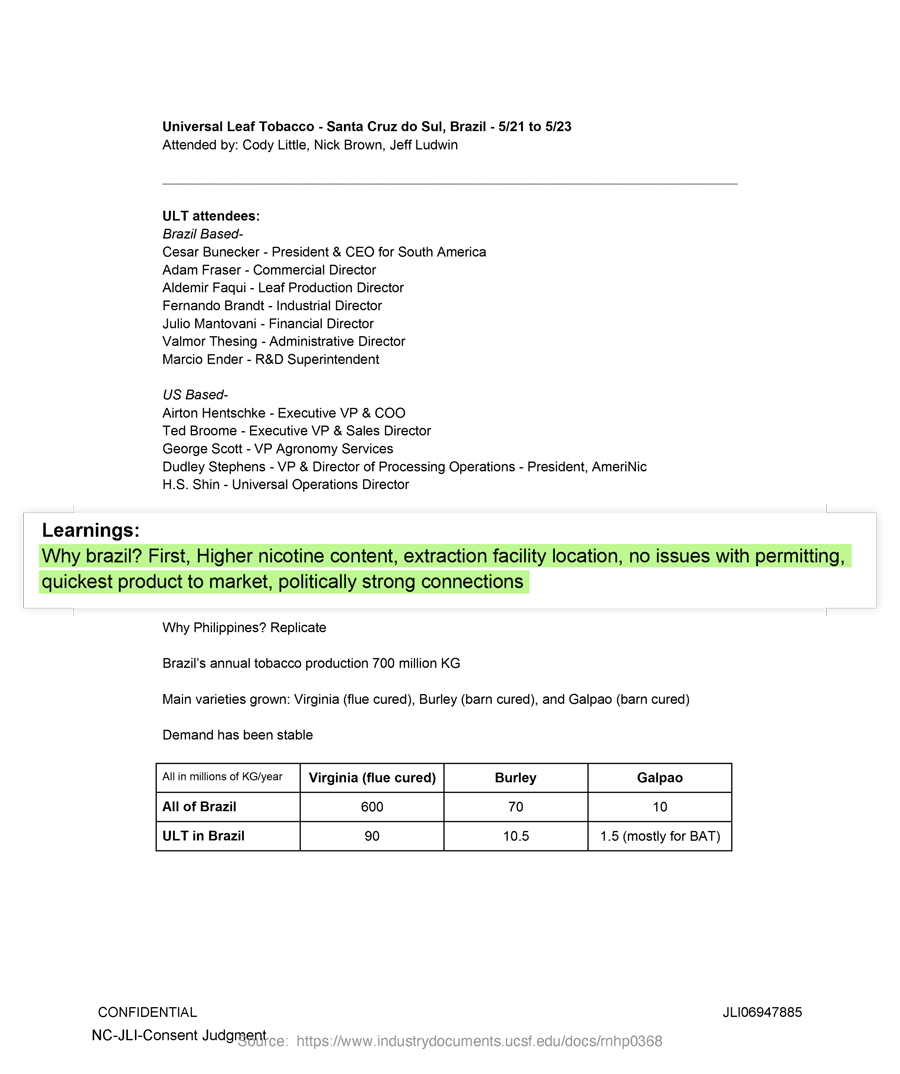
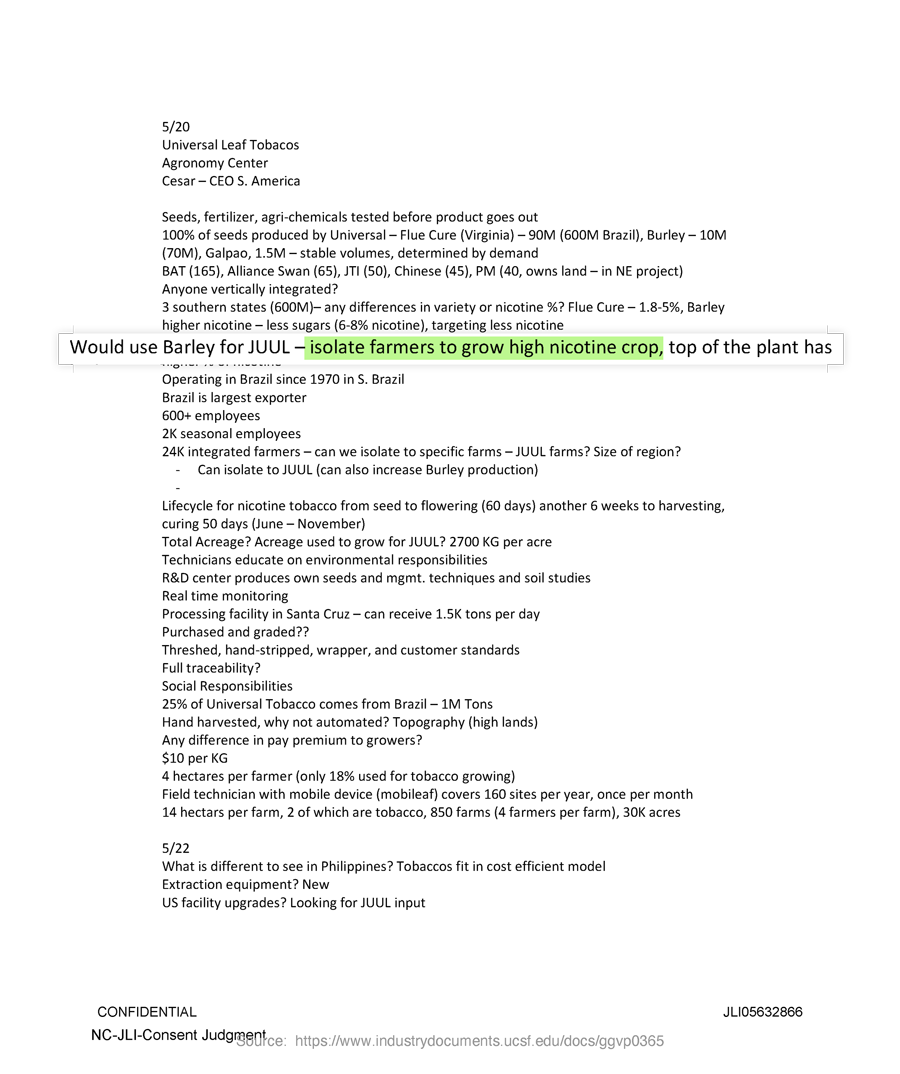
Universal Leaf's presentation to JUUL makes the case for anchoring the vape company's global supply chain in Brazil
In a second document, a JUUL employee recorded meeting notes that detail how Universal Leaf intended to put its integrated farmers at the company's disposal. "[Universal] would isolate farmers to grow high-nicotine crops," he wrote. "Can we isolate [production] for specific farms — JUUL farms?" he continues. The notes then indicate yes.
For this, dark burley-type tobacco would be selected. This variety is grown by fewer than 25% of Brazilian producers and, in general, in regions near the border with Argentina. Unlike virginia-type tobacco, the most widely grown and exported in the country, burley is cured in sheds rather than wood-fired kilns, and is harvested whole rather than leaf by leaf. The price paid to the producer is, on average, 14% lower. In this case, the document spoke precisely of the KY 171 variety, which is not grown in Brazil and is not registered with the Ministry of Agriculture (Mapa).
But Universal Leaf's plan did not work out. JUUL preferred, in the short term, to use Indian nicotine, made cheaply from the leftovers of the industrial processing of bidi, a tobacco typical of the Asian country, and to bet on laboratory production of synthetic nicotine in the long term. The visit to Rio Grande do Sul was in reality just to learn about the market. "This trip is more to visualize their [Universal's] leaf extraction process," a JUUL employee said in an email exchange that discussed the visit to the country.

At that point, the company was even evaluating hiring Universal Leaf as a supplier, but preferred to set up in Asia, in places such as the Philippines or Indonesia. It also did not help that e-cigarettes had been banned in the country since 2009. "Kevin [Burns, the company's CEO at the time] is not optimistic about Brazil and basically sees it as a money pit," a JUUL executive wrote during the series of emails.
One of the factors that convinced JUUL to prefer synthetic nicotine over tobacco-extracted nicotine in the long term was precisely price. At the time, the laboratory-produced substance was more expensive due to lack of scale — the bulk of the market is still dominated by low-cost Indian bidi. JUUL's spreadsheets indicate, however, that for the demand the brand projected, while Universal's nicotine foresaw costs of up to $350 per kilogram (about R$ 1,900), synthetic would cost around $300 (around R$ 1,600) if purchased in larger volumes.
"The industry should start trying to decouple nicotine's image from tobacco, in an attempt to present the substance in a positive way"
— Erwin Henriquez, Euromonitor
A source connected to a nicotine manufacturer interviewed by the report said that today, six years after JUUL's estimates, the costs of synthetic nicotine production are lower. It is these lower prices, for example, that guarantee scale and competitiveness for vapes produced in China, which dominate even legal markets, such as the US, and illegal ones, such as Brazil.
"Synthetic nicotine is much cheaper," Erwin Henriquez, senior consultant for the nicotine industry at Euromonitor — an international business intelligence consultancy that advises several industries including tobacco — confirmed to Joio. "That, actually, is one of the reasons why products like disposable vapes can be produced at scale and so quickly."
In Henriquez's assessment, in the long term, synthetic and tobacco-extracted nicotine should attract different consumer profiles, and the very idea of tobacco as synonymous with the substance will lose ground. "The industry should start trying to decouple the image of nicotine from the image of tobacco, in an attempt to present the substance in a positive way," says the consultant. "In general, I believe that synthetic nicotine's share of the global market will grow steadily over the next five years, capturing a significant slice, especially as the industry continues to decouple nicotine consumption from combustion and, increasingly, from tobacco itself."
However, the short-term impact will be minimal. "The big tobacco companies have a very strong hold on the global leaf tobacco supply chain, so it is in their interest to maintain that structure as a barrier to entry for smaller new competitors who could threaten their position," he assesses. Furthermore, regulators may try to favor tobacco-extracted nicotine to prevent the advance of the laboratory-produced kind.


Most e-cigarettes use parts produced in China. In some cases, "illicit" vapes and those produced by multinationals share the same Chinese suppliers (Photo: Isabelle Rieger/O Joio e O Trigo)
Universal Leaf's project, however, did not die with JUUL's refusal. On the multinational's team that participated in the 2019 meetings was Valmor Thesing, the company's administrative director.
Years later, in 2024, he left the role to take over the presidency of the Interstate Tobacco Industries Union (SindiTabaco), an entity that brings together the main companies operating in the sector in Brazil, including Universal Leaf itself, and is one of those responsible for the tobacco lobby with politicians, governments, and the press. The union confirmed Thesing's participation in the meetings with the vape brand.
"At that time, JUUL was prospecting, internationally, future suppliers of raw materials and one of the companies selected was Universal Leaf through its US parent company," the entity said in a statement. "Due to contractual confidentiality commitments, which remain in force after the executive's departure, there are no comments to be made on the content of internal company meetings."
Since he took over the SindiTabaco presidency last year, one of Thesing's main arguments for legalizing e-cigarettes is that they would open the Brazilian market to the production of tobacco-extracted nicotine.
"I think Brazil is missing a huge opportunity by not releasing final products [vapes] here in Brazil," Thesing told Joio in late March, weeks before the documents detailing his meeting with JUUL were made available by Truth Tobacco Industry. "I'm talking about the production of liquid nicotine and other leaf by-products that Brazil has in abundance, and we are discussing this because of an Anvisa resolution that makes no sense at all," he said.
The regulatory agency, however, told the report that it "does not establish rules for how nicotine is extracted from the plant" nor "regulate the extraction of the substance." In other words, the country would have no restrictions on the production and export of pure nicotine, only on its "conversion into a smoking product" — that is, its mixing with the solvents that produce the liquids in electronic devices.
Brazil's situation is similar to India's, the world's largest manufacturer of this input. Vapes were banned in the country in 2019, but it is Indian-origin nicotine that supplies most of the global market. The conversion of the country's nicotine into vape liquids is usually done in factories in China, the US, and Switzerland.


Tobacco shredded in factories goes directly into cigarettes, but by-products such as processing dust, stems, and veins can be used to produce everything from liquid nicotine to reconstituted tobacco, an extremely processed version of the leaf that can be used in conventional cigarettes or electronic devices (Photo: Isabelle Rieger/O Joio e O Trigo)
SindiTabaco, however, blames Anvisa for the "missed opportunity." The entity told Joio that, even though the agency does not prohibit nicotine extraction per se, it bans exports if the commercial destination of the raw material is the production of vape liquids. Around the same time Universal Leaf presented its plan to JUUL, the company had sought authorization from Anvisa to produce liquid nicotine and export it, but the request was denied and "the prospecting study" ended, said the union.
The entity also stated that the preference for burley "would be an opportunity for these producers, who had been seeing a decrease in demand, to continue producing."
The promise of income for the countryside from nicotine extraction has become an argument for vape legalization in the mouths of politicians who say they defend tobacco farmers. The rhetoric took hold, for example, with the Legislative Assembly of Rio Grande do Sul, the country's largest tobacco-producing state, responsible for around 40% of national production.
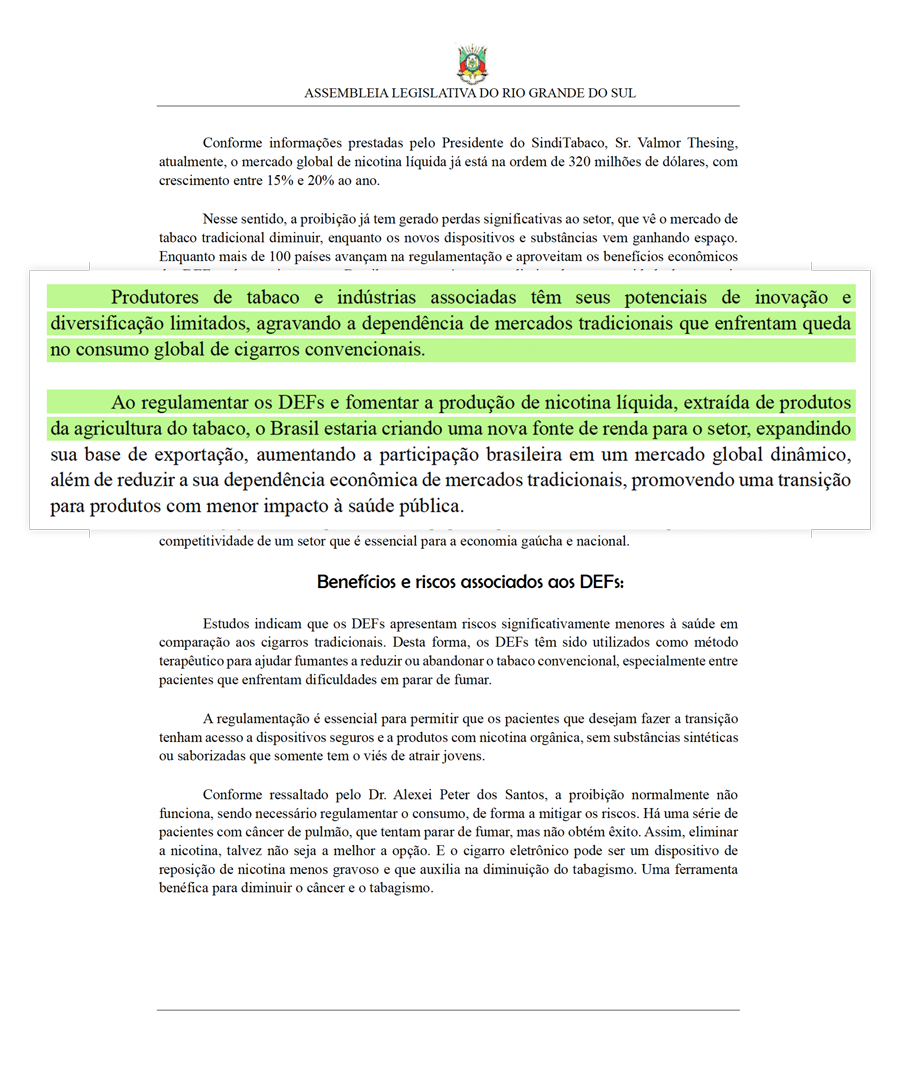
In early July of that year, state deputies in Rio Grande do Sul approved a report — with support from SindiTabaco and BAT — that suggested vapes could protect tobacco farming from the global decline in tobacco consumption. "Tobacco producers and associated industries have their innovation and diversification potential limited, aggravating dependence on traditional markets facing falling consumption of conventional cigarettes," the document states.
"By regulating DEFs [electronic smoking devices] and fostering the production of liquid nicotine, extracted from tobacco agriculture products, Brazil would be creating a new source of income for the sector," the report guarantees. Its rapporteur, state deputy Marcus Vinícius from Progressistas, did not respond to Joio's interview requests.
The concern about the sector's future does have some basis, since governments have been making efforts to combat cigarette consumption worldwide. The product kills more than eight million people a year, according to the World Health Organization (WHO). This figure surpasses the total deaths from the Covid-19 pandemic, which claimed about eight million lives between 2020 and 2023. In Brazil alone, there are 161,000 deaths linked to smoking per year, according to the National Cancer Institute (Inca).
For this reason, it is no wonder that global product consumption has fallen from 5.9 trillion units in 2007 to 5.1 trillion in 2020, a decline driven by public health measures, according to tobacco yearbooks reviewed by Joio. The decrease in demand has also impacted the number of tobacco producers in Brazil: there were 236,000 tobacco farmers in 2005, 71% more than today.
The world's largest tobacco exporter, Brazil is also seeing exports declining. From 626,000 tonnes in 2005 to 446,000 in 2024, according to foreign trade data from the Ministry of Development, Industry, Trade and Services (MDIC).


Lara shows tobacco processing by-products. The dust can be used to produce everything from liquid nicotine to reconstituted tobacco, an extremely processed version of the leaf that can be used in conventional cigarettes or electronic devices (Photo: Isabelle Rieger/O Joio e O Trigo)
While multinationals pressure for the release of electronic devices to open this market in Brazil, smaller industries are already moving to export Brazilian tobacco and meet demand for pure nicotine, which can also be used in heated tobacco devices and pouches — both popular in various Asian and European countries. This is the case of tobacco processing company Unicruz, based in Vera Cruz, a city neighboring "tobacco capital" Santa Cruz do Sul, which has projects — still under development — to buy and sell tobacco to nicotine extractors.
The lack of cultivation of high-nicotine varieties, such as those planned by Universal Leaf, is, however, an obstacle. "They look for very high-nicotine tobacco that is not produced here as it is in other countries," explains Unicruz operations director Jonas Lara. "Today the tobacco grown in Brazil is aimed directly at cigarettes, but over time they will probably grow some variety with a higher [nicotine] content here," he assesses.
Farmer Ernani Konzen, 50, surveys part of the eight hectares of his farm — five owned, three rented — where his family will plant around 100,000 tobacco plants this harvest. It is there that he, his son João, 21, and his wife Cristiane, 41, have for 14 years grown the leaf they now supply to BAT and Philip Morris.
The family from the rural area of Santa Cruz do Sul struggles to make a living from crops other than tobacco on the little land they have on their property. "I got into corn farming years ago and ended up paying to plant because at selling time the price didn't cover production costs," says Ernani. "The only thing for us today that's making money, profit, is tobacco."
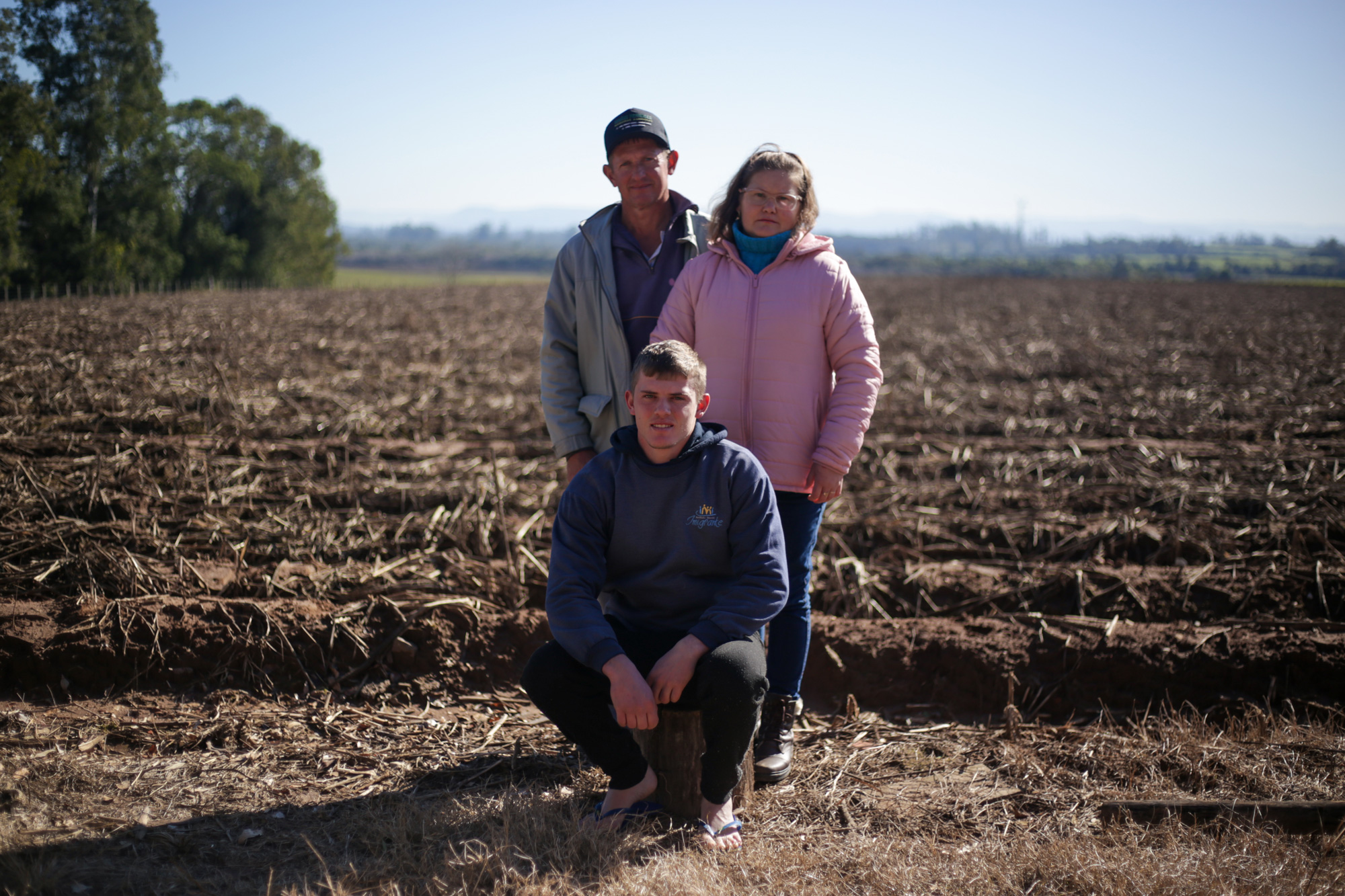
In many of the tobacco-growing regions of southern Brazil, producers who "venture" into other crops face difficulties, as the economic logistics in many of these cities are entirely focused on tobacco's production chain. In municipalities such as Vera Cruz and Santa Cruz do Sul, for example, most of the region's supermarkets buy food from distribution centers in the capital Porto Alegre, over 150 kilometers away, rather than from local producers.
The country even has a public policy — the National Program for Diversification of Areas Cultivated with Tobacco (PNDACT) — to help tobacco farmers find other sources of income beyond tobacco, given that the long-term trend from falling conventional cigarette use is a decrease in demand for the leaf. The program had some editions between 2011 and 2019, but never really took off. Today it remains shelved by the Lula government in the Ministry of Agrarian Development (MDA).
However, farmers still have little clarity about what e-cigarettes are and what risks they may pose to the crop. "We hear about it in the media, but in terms of companies, they don't report anything about this with us yet," says Ernani. "The only thing they say is that producers who achieve quality will never have to worry because those will always find a market."
Even politicians who defend tobacco production, such as federal deputy Heitor Schuch (PSB), who is from Santa Cruz do Sul, have not received clear answers from the industry when they ask whether e-cigarettes demand less tobacco than conventional ones. "The impression is that there are still few concrete data on the real impact of electronic devices on tobacco demand," he said in a statement to Joio. "The farmer, in general, wants to produce and have income to support the family, and is not directly involved in this discussion."
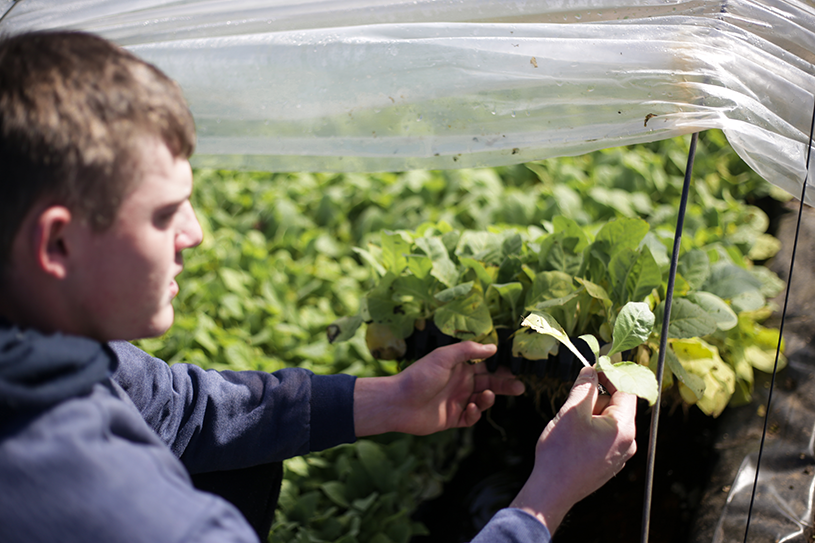
In late March, SindiTabaco president Valmor Thesing, who participated in Universal Leaf's meetings with JUUL, told Joio he had no "technical data" on whether liquid nicotine needs fewer leaves to be produced, and said the entity would initiate a "dialogue" with cigarette companies to talk with producer representatives on the subject.
The entity's leader also suggested it would be "excellent for Brazil" if demand for tobacco with impacts on rural production were to fall. "Our government only says we should 'diversify' producers, or rather, we should end tobacco production so they produce food," he said. "So if the need for tobacco producers decreases, we put diversification with them and address what the government wants."
During the conversation, Thesing said that, with e-cigarettes, the sector has its eye on "the smokers of the future." "Do you believe that future generations will smoke traditional cigarettes, if they smoke, or will they smoke new products? Who decides what [is] consumed? Is it the industry or the user?" he asked. "Without addictions, humanity cannot live."