

Lula Government Delays Tobacco Growing Phase-Out Program
The initiative has been sitting in the minister of Agrarian Development's office since December 2024. Without support from public policies, farmers in tobacco-growing regions face losses when trying to invest in other crops.
*contributed Raquel Torres
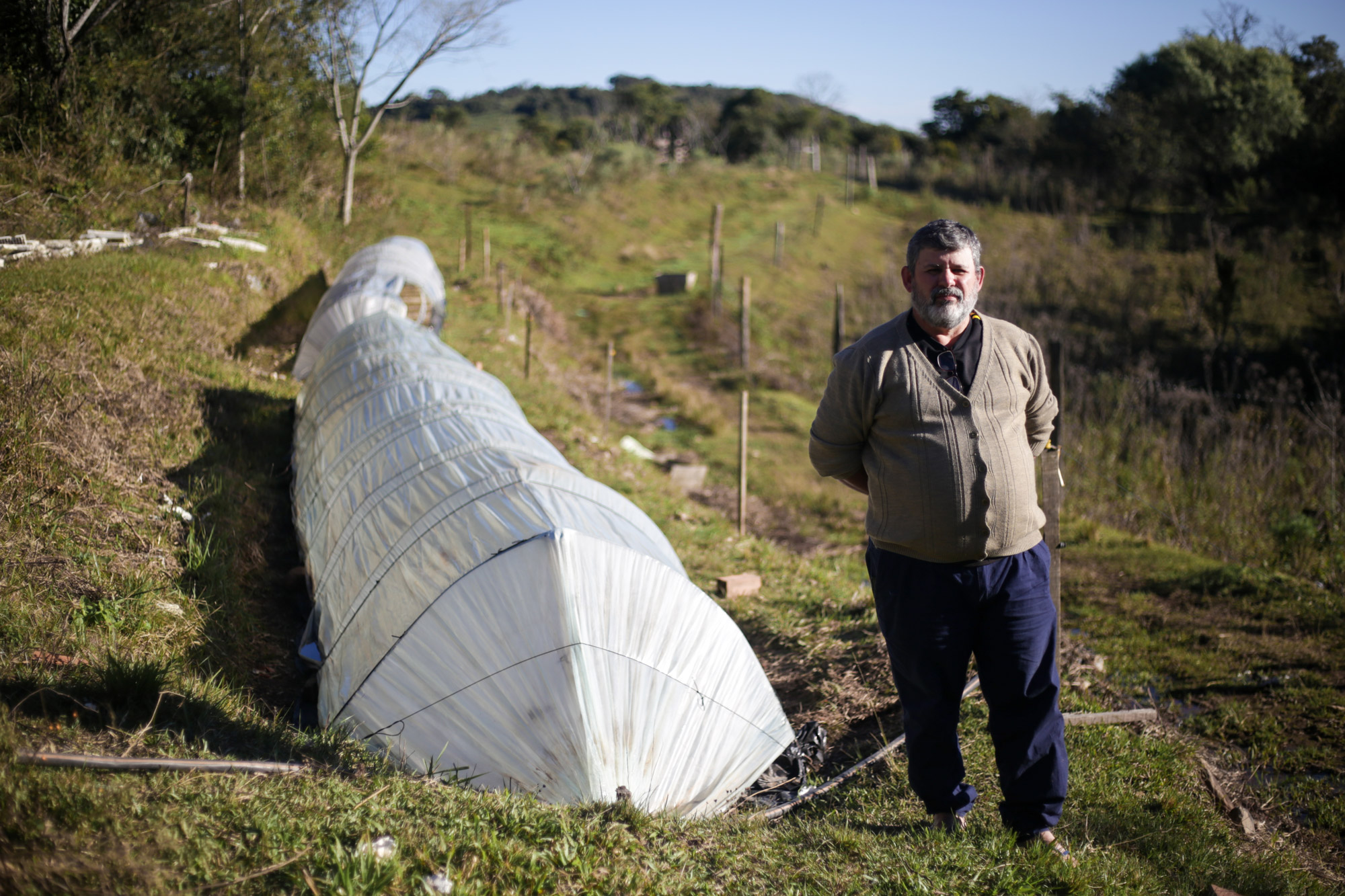
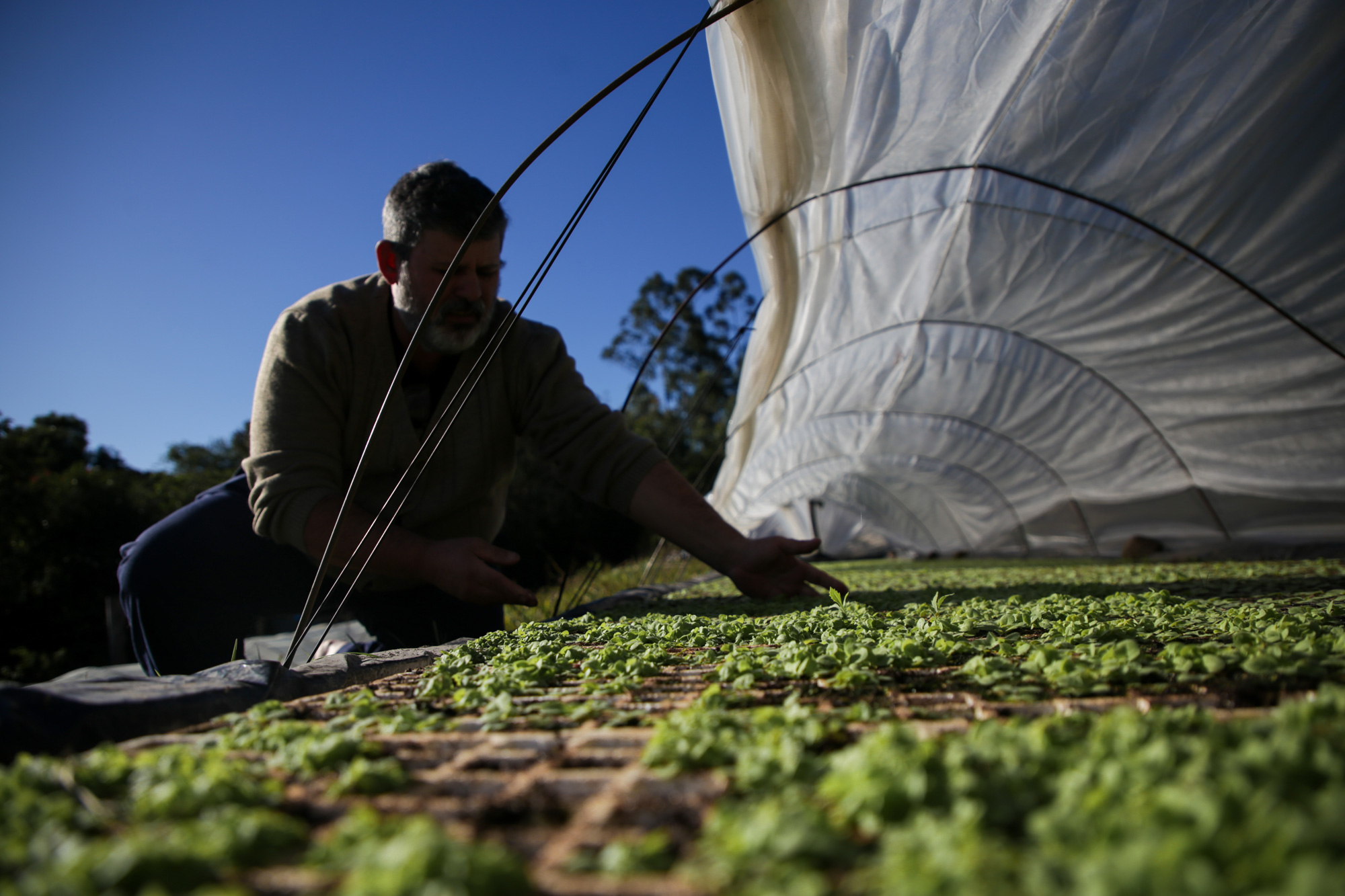
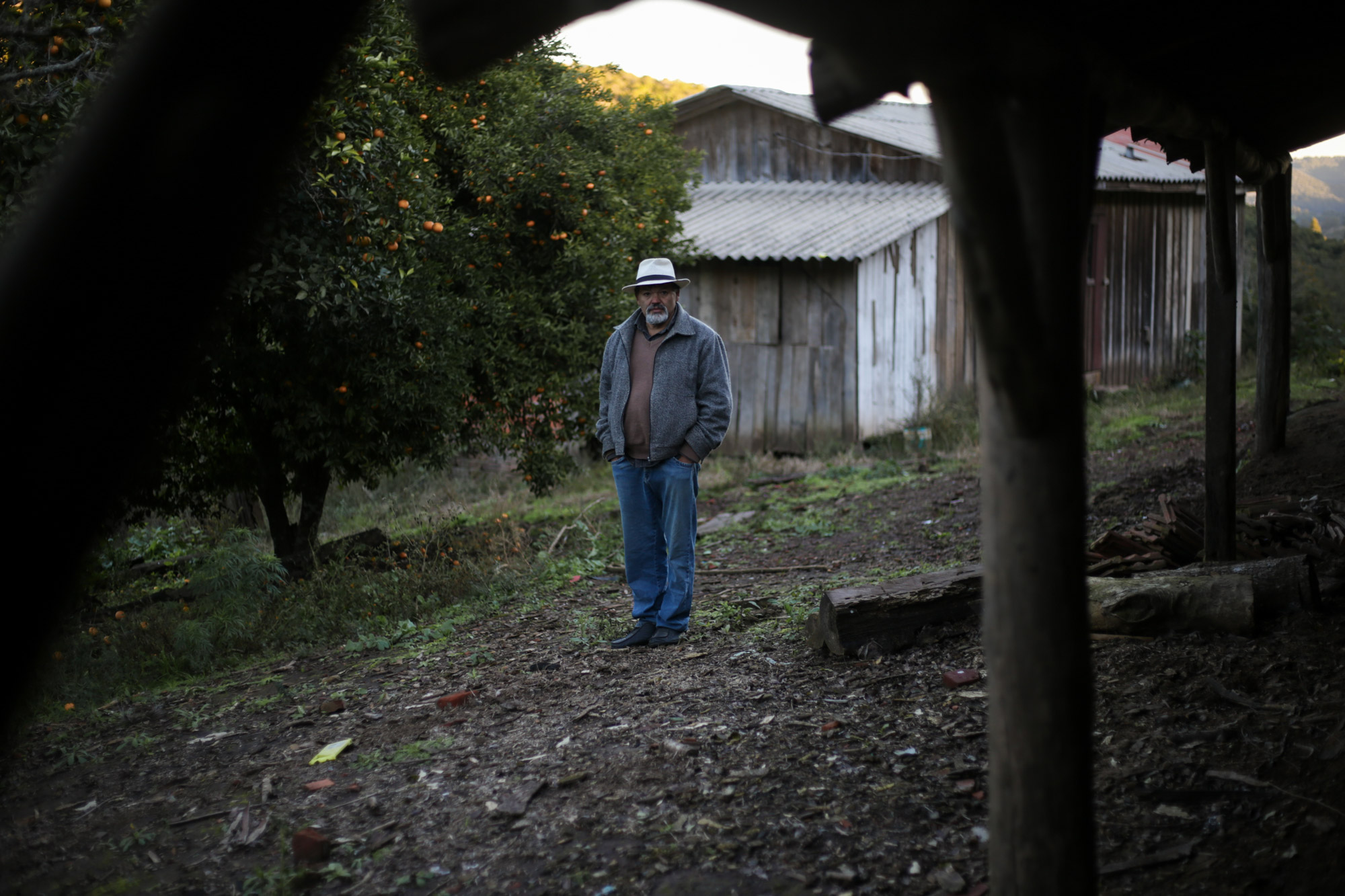
Farmer Paulo Sérgio Padilha, 53, has been growing tobacco since age seven, but after this harvest he will sell the approximately 33 hectares of land where he lives with his wife and retire from cultivation. He will leave behind orchards of citrus, plantings of corn, beans, and potatoes, cattle, and a small food-preserving agro-industry — alternatives to tobacco that he tried, without success, to make viable. In the mountain area of Sinimbu, a municipality of 10,000 inhabitants in the central region of Rio Grande do Sul, if the plan is to leave tobacco growing, the simplest answer is to move away.
Years ago, the farmer even had organic certification and sold grains and vegetables for school meals. From 2016 onward, when funds from federal programs such as the Food Acquisition Program (PAA) and the School Feeding Program (Pnae) dwindled, only tobacco companies remained as clients. "There was a time when we took 500 kilos of sweet potato every week to the cooperative and sold them for R$2 a kilo, so it was worth it. But then they started asking for only 18, 20 kilos," recalls Padilha. "That's why we had to go back to tobacco."
In the region where he lives, the land and roads are uneven and steep, surrounded by hillsides and embankments, which makes it difficult to move any product whose logistics are not already established, as is the case with tobacco.
"What sustains this culture and keeps tobacco on the property is the market: you are sure they will buy, even without knowing for how much you'll sell," explains Padilha, who this harvest plans to grow his last 50,000 plants for Alliance One, a multinational that supplies the leaf for Chinese cigarettes and other major companies such as Japan Tobacco International (JTI, maker of Camel) and Philip Morris International (maker of Marlboro).
According to estimates from the Brazilian Tobacco Farmers Association (Afubra), there were more than 138,000 tobacco producers in the last 2024/25 harvest, most of them family farmers in the South region, like Padilha. The number, however, has been higher. In 2004/05, it was around 236,000.
The same applies to foreign trade. The world's largest leaf exporter, Brazil sold 446,000 tonnes abroad in 2024, 28% less compared to 2005, according to figures from the Ministry of Development, Industry, Trade and Services (MDIC). The drop in the period was driven by the global reduction in cigarette use, driven by public health measures.
A global treaty negotiated in the early 2000s, the Framework Convention on Tobacco Control (FCTC), is responsible for part of this decline. Coordinated by the World Health Organization (WHO), it has been ratified by 192 countries. Brazil's entry into the agreement in 2006, however, faced strong resistance from the tobacco industry and farmers. So when signing it, the Brazilian government promised to create policies that would support farmers in diversifying their crops to other cultures beyond tobacco, given that efforts to combat cigarette use would lead to reduced demand for the leaf.
However, nearly 20 years later, rural producers still struggle to find viable alternatives to tobacco growing. Many of those who age — and no longer have the strength or health for the intense work tobacco requires — rent out their land or sell it. Their children have no interest in living in the countryside, much less growing the leaf. Larger producers acquire the farms of small ones who retire, and the production profile of family agriculture migrates to agricultural commodities grown in large areas, such as soybean.
According to data from the Brazilian Institute of Geography and Statistics (IBGE), 41% of the planted area in Sinimbu in 2003 was tobacco, and there was not a single square meter of soybean. In 2023, the leaf occupied 35% of the municipality's crops, while the grain had already advanced to nearly 19% of them. Meanwhile, the area of beans — food grown for self-consumption by tobacco farmers — fell from 7% to 2% in the same period.


Farmer Paulo Sérgio Padilha spent around R$ 100,000 setting up a jam and preserve agro-industry that ended up with its equipment and products abandoned (Photo: Isabelle Rieger/O Joio e O Trigo)
The industry itself also does not help: tobacco companies and rural entities treat diversification programs as "attacks" aimed at "eliminating" tobacco farming — the great driver of income for family farmers in various southern regions of the country. At the same time, the sector also denies that small producers are dependent on cultivation. The goal is to frame any public policy related to tobacco control as a blow struck against tobacco farmers — and therefore against family farming.
"The maxim that tobacco is the only crop that generates income and profit on a small property becomes inscribed in producers' mindset," explains geographer Virgínia Etges, professor at the University of Santa Cruz do Sul (Unisc), the city that concentrates the sector's companies. "And they become closed off to that."
According to Afubra, on average, 56% of tobacco farmers' gross income comes from the leaf, while food crops and livestock account for the rest. In practice, however, part of this "alternative" volume goes to self-consumption.
In 2005, the federal government created the National Program for Diversification of Areas Cultivated with Tobacco (PNDACT) to boost the transition from tobacco farming to other forms of income, as part of FCTC negotiations. The project was created to try to mitigate the impacts of falling cigarette demand on the country's tobacco farming, had some editions, and followed a model in which contracted entities provided technical assistance to families in the search for alternatives to tobacco, but never really took off.
"We have producers who had stopped growing tobacco 100%, but came back after some time out of necessity," explains Vilmar Sergiki, president of Ceasol, an entity that implemented the PNDACT in the São João do Triunfo region, in the south-central of Paraná. In his assessment, the lack of a market with guaranteed purchase for other crops hinders this transition, pointing to the need for broader policies.
In the country, tobacco companies operate in an integrated system in which they "contract" rural producers to supply them with the leaf. In this scheme, the company orders a certain amount of tobacco plants from the producer, supplies the inputs (seeds, pesticides, fertilizers, etc.), provides guidance, and guarantees the purchase of the ordered volume at the end of the harvest. (The value, however, is discounted for the cost of the inputs supplied, which are not given for free by the tobacco company. If the producer does not fulfill the initial order, they go into debt).
The advance sale gives a sense of security, causing many farmers to return to tobacco growing at the first sign of instability in other markets, such as grains, vegetables, or dairy. "Tobacco also has these price fluctuations, but at least it guarantees the sale, even if it's bad," explains Sergiki.
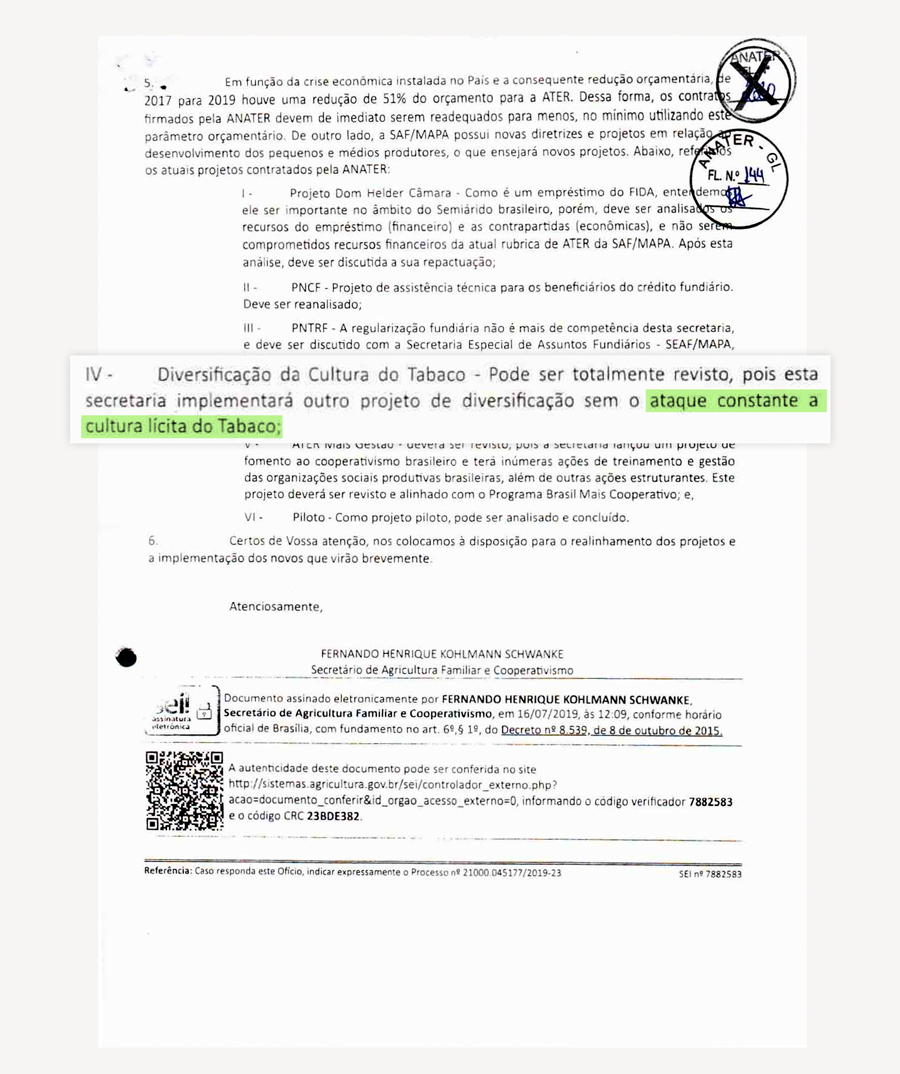
In 2019, the Jair Bolsonaro government blocked the diversification program for considering it a "constant attack on the lawful culture of tobacco," according to a Ministry of Agriculture memo from the time reviewed by Joio. For this reason, the initiative was frozen.
In early 2024, at the last Framework Convention conference, the Ministry of Agrarian Development (MDA) even announced the resumption of the PNDACT, but the measure has been stalled in Minister Paulo Teixeira's office since December of that year. When questioned, the ministry is evasive about the reason for the delay in the launch. The ministry promised Joio it would relaunch the program by March 2026.
In April this year, the Federal Court of Accounts (TCU) released the results of an audit that identified several problems in MDA initiatives, such as the lack of guidelines in creating projects, contracts and partnerships with wrong deadlines, and omissions in monitoring program results. It is no wonder that data on recent editions of the PNDACT are lacking — for example, whether producers returned to tobacco at the end of the projects, and whether alternative crops succeeded.
According to Freedom of Information Act (LAI) requests made by the report, the only evaluation document of the program available to the ministry is a nine-page report referring to bids implemented between 2018 and 2023. Without detailing the data, the material claims that nearly half of the approximately 1,200 tobacco farmers benefited would have switched to corn as their "main activity," attesting to the program's success. Dairy cattle, horticulture, and bean production would also have emerged as options in the remaining cases. However, it does not say in which regions these crops succeeded, how much income they brought, nor does it clarify whether tobacco stopped being grown on these properties.
The National Agency for Technical Assistance and Rural Extension (Anater), which was responsible for implementing the recent editions of the tobacco diversification program, told Joio that "through its Technical Board, it has not received any guidelines or memo regarding a new tobacco crop diversification program" to date. The body also stated that it carries out its programs and actions based on objectives, target audiences, territories, and resources defined by MDA.
The ministry even created a work plan to resolve the problems identified by the TCU audit, which includes agreeing on a new "management contract" between MDA and Anater by December this year. The launch of the PNDACT should only happen after the document is signed, since the agency will be responsible for implementing it. The program guidelines are in the final stages of preparation, according to the ministry.
"We in civil society had already been calling for this program to be resumed because, although it had even received some international recognition for a certain period, it was greatly hollowed out," says Mônica Andreis, director of the NGO ACT, which fights for tobacco control measures. "We welcomed the announcement [of the resumption], but we have not seen it materialize since."
Even so, the plan under discussion is timid. The pilot version of the new project plans to serve 300 family farming families in the South region through public bids and calls for technical assistance, in lines similar to past editions. There is even budgeted funding — around R$ 3 million, ministry officials told Joio in April. A low amount compared to previous years, when PNDACT bids reached R$ 26 million and served up to 7,000 farmers, as in 2018.
The MDA did not respond to why the tobacco diversification program has still not been launched. In a statement, the ministry said "the subject is being handled with the seriousness and responsibility required, considering the challenges and articulations needed." The ministry did not respond to questions about the TCU audit results, and limited itself to saying it is unaware of audits "specifically" or "directly related" to the PNDACT.
While the government's support program for tobacco farmers has not been resumed, the cigarette industry has moved ahead to launch its own initiatives. In late March, the Interstate Tobacco Industries Union (SindiTabaco), which represents tobacco companies in the South of the country, released a revamped version of an initiative launched in the 1980s by the former Souza Cruz, now British American Tobacco (BAT). At the time, the proposal was to encourage producers to plant corn or beans in the off-season. Now it is called "Tobacco is Agro: Property Diversification."
At the launch event, in a small auditorium with around 30 seats during Expoagro Afubra, one of the main agricultural fairs in Rio Grande do Sul, the union's president, Valmor Thesing, indicated that the new program is part of the sector's mobilization on the eve of the tobacco COP, the gathering of countries signatory to the Framework Convention. "We are in a COP year and they are already announcing they will attack the whole production chain again," said Thesing. "First, that we have to eliminate tobacco production because the producers are not diversified: lies!"
In June, Joio asked the union to indicate farmers who had already participated in the new program so they could tell the report how joining the project contributed to their growing other crops. But SindiTabaco preferred not to indicate anyone or give further details about how the project operates.
According to farmer Sergio Padilha, this type of "incentive" to diversification is limited to offering, for example, grain seeds when ordering inputs at the start of each harvest. Just like other agrochemicals supplied for tobacco growing, the costs of "diversification" are also deducted from the producer's payment when the tobacco is sold. "If I'm going to buy transgenic corn, I'll go to a farm supply store and buy for R$ 600 the same product the company sells you for R$ 1,100," he criticizes.


Philip Morris maintains a cigarette factory in Santa Cruz do Sul, Brazil, while claiming to be committed to a "smoke-free future" (Photos: Isabelle Rieger/O Joio e O Trigo)
At the same event, SindiTabaco also announced a project with the Brazilian Agricultural Research Corporation (Embrapa), a federal government state company. The program was named "Protected Soil" and will select 33 properties in the South region to test good management practices in tobacco production until 2029. The initiative was adapted from a partnership Embrapa already had with cigarette company Philip Morris since 2019, called "Auêra" and created to, in the company's words, "promote sustainable tobacco production."
"This is the logic: to strengthen and improve the soil so as to have tobacco with greater productivity, better quality, but also to work on crop diversification," Waldyr Stumpf, then head of Embrapa Clima Temperado, which signed the cooperation agreement with the union, told Joio. "We are not focusing on replacing [tobacco], but rather that [the producer] also produces beyond tobacco, because they already have an established market, but we would also like them to work with beans, corn, vegetables, peaches, strawberries," he said.
The initiatives, however, have not indicated any form of support for the marketing of these crops — the main obstacle to diversification. "Today we already have other crops that make more money than tobacco, except the marketing part is the big bottleneck," says Sergiki from Ceasol, who has worked with producers of vegetables and fruits — such as lettuce and strawberries — who left tobacco and did not return. "The farmer knows how to produce, but doesn't know how to sell."

Finding buyers, however, should not be a challenge. In the Vale do Rio Pardo, one of the main tobacco-growing regions of Rio Grande do Sul, which encompasses municipalities such as Santa Cruz do Sul, Sinimbu, and Venâncio Aires, there is a shortage of food that reaches demand. However, there is no shortage of tobacco industry — based there are the factory units of cigarette makers such as Philip Morris and JTI, tobacco processors, and multinationals that export Brazilian leaf.
"A large volume [of food] is sourced, for example, from Porto Alegre's Ceasa [distribution center 166 km away], to supply supermarkets here," Gilson Becker, mayor of Vera Cruz — a municipality neighboring Santa Cruz do Sul — who also heads the Association of Tobacco-Producing Municipalities (Amprotabaco), one of the entities that support the tobacco sector's interests, told Joio. "So there is quite an expressive market niche that can be tapped and that, today, does not yet have sufficient production volume to meet local demand."
According to Becker, Amprotabaco supports diversification but has no coordinated action to support this type of policy, which falls to each municipality. In practice, this means that initiatives supporting alternatives to tobacco are diluted into the actions that agricultural secretariats and rural technical assistance teams already carry out for small inland producers in general, whether tobacco farmers or not.

Until 2019, farmer Valderi de Moura, 59, used to plant around 2.5 hectares of tobacco — about 40,000 plants — on his property in the interior of Sinimbu. Since then, he has been renting part of his 23 hectares of land to neighbors and is now testing citrus cultivation, in an attempt to find a good alternative to the leaf. "The idea is to bet on something that has a certain return with a labor demand that is not so great," he explains. The initial test will be to plant citrus on about half a hectare of the property.
The initiative is part of a project by the municipality of Sinimbu that includes Moura and eight other rural producers. Each one received a small municipal incentive to invest in fruit trees. "Up to R$ 4,000, they refund half the value [R$ 2,000]," he says. One of eleven siblings of illiterate parents, the farmer learned to grow tobacco when still young. Today, his daughter, who is studying Agroecology and works at a cooperative, helps with the orchards — which may also give her a way to market the production.
Meanwhile, Moura's main source of income remains renting part of his land. The advance of soybean in the surroundings of his property, however, worries him. There are neighbors who use drones to spray their crops with pesticides and the former tobacco farmer fears the chemicals could drift onto his orchards, which are being cultivated organically.
Until he retired from tobacco, Moura was an integrated producer for Continental Tabacos (CTA), a Brazilian tobacco company that is a subsidiary of US-based Hail&Cotton, which supplies the leaf for the global market, as does Alliance One. They are among the various exporters that push Brazil to the global leadership in the sector — and may face difficulties as demand for tobacco continues to fall in the long term, even though smoking remains strong in some populous Asian countries, such as China and Indonesia.


However, the advance of e-cigarettes could accelerate this fall in demand, since thousands of vapes can be powered by the nicotine from just a few hundred farmers' tobacco. It is no wonder that leaf suppliers such as Alliance One itself, for example, see these new products as a risk to business.
"Some of our most significant customers, including Philip Morris International and British American Tobacco [which produces brands Kent and Lucky Strike], have publicly announced intentions to move toward smoke-free products [vapes, heated tobacco, and pouches] that would substitute for traditional cigarettes," notes Pyxus' 2024 investor report, the holding company that owns Alliance One.
"Generally, smoke-free products require less tobacco in their production than traditional cigarettes. An increasing trend of substituting traditional cigarettes with smoke-free products, driven by our customers or consumers, could materially and adversely affect the results of our operations," concludes one of the passages, in the report's business risk section.
Another major tobacco supplier, US-based Universal Leaf, also faces the issue cautiously. According to a shareholder presentation on the company's activities in 2024, the company considers the "effects on leaf tobacco demand" of new nicotine products to be "still uncertain or evolving."
In the current market status, however, the tobacco company notes that "all major tobacco manufacturers are creating new generation products" and that they "use fewer leaf tobacco in a strict one-to-one comparison with a combustible cigarette." The multinational, on the other hand, is already investing in liquid nicotine production so as not to fall behind in the supply chain for vapes.
Even so, entities that should theoretically defend the public interest — such as the mayors' network Amprotabaco — support the legalization of electronic devices without discussing measures that could alleviate the impact of this advance on tobacco farmers in their municipalities. Since the country exports around 90% of the tobacco it produces, the risk is independent of a domestic market legalization. Today, cigarette companies such as BAT and Philip Morris already have between 17% and 40% of their profits from "smoke-free products" — and the goal of both, as described in annual shareholder reports, is that by 2035 the new product portfolio will match the revenues of traditional ones.
In the assessment of Romeu Schneider, president of the Tobacco Sectoral Chamber, an advisory body linked to the Ministry of Agriculture that brings together representatives of the industry and tobacco farmers, the advance of vapes resembles the emergence of what is now the conventional cigarette — once called the "paper cigarette" — which supplanted the consumption of hand-rolled cigarettes and rope tobacco decades ago.

"This migration will also happen, in our view, with electronic smoking devices," assesses Schneider, a former Afubra president. "We believe the consumer will determine this shift from one form of consumption to another and, obviously, those who supply the products need to gradually adapt."
For many decades, rope tobacco production — a darker, rustic tobacco used in hand-rolled cigarettes and cigars — was concentrated in the Northeast region, mainly in the interior of Alagoas. From the 1990s on, the market dwindled and today there are hundreds of tobacco farmers who, with great difficulty, remain in the crop. With low demand, each planted hectare yields R$ 10,000 gross per year for an entire harvest, Joio showed. There, not even the PNDACT initiatives — directed mostly at the South region — have reached.